Beyond the Lab: Who Benefits from Innovation and How Do We Know?
 nwi admin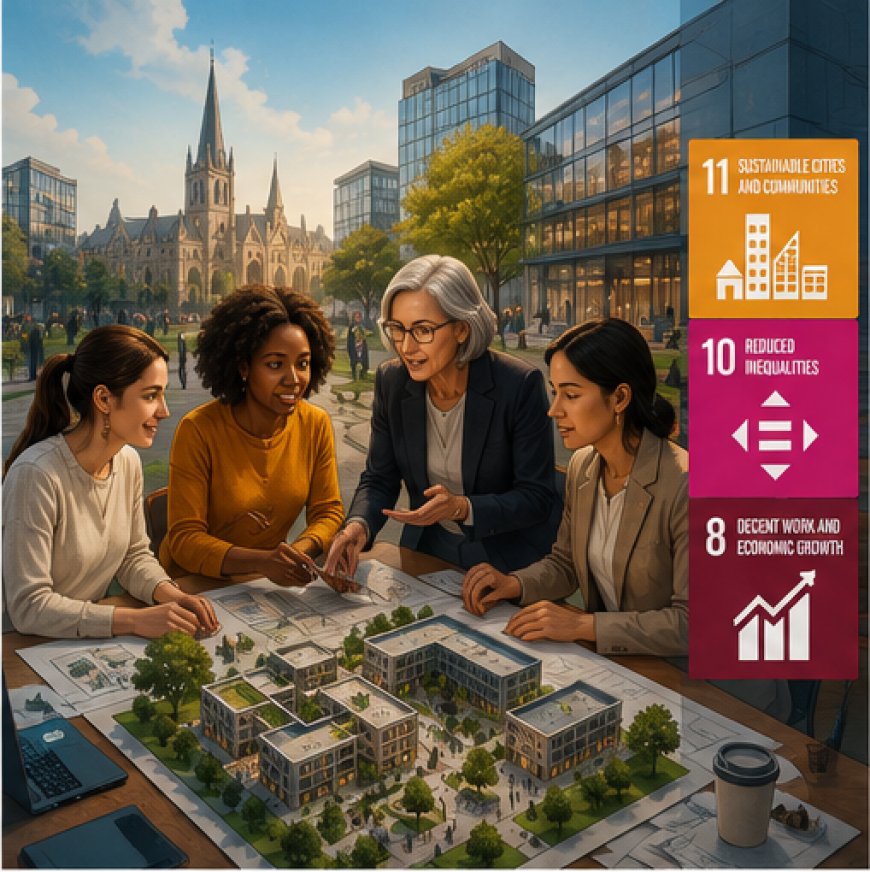
Author: Ms. Alejandra Amor Pinacho (Fellows; 2025-2026 batch; from Spain)
Alejandra Amor Pinacho is a policy professional based in Cambridge, United Kingdom, where she works within the Policy and Strategy Team at Cambridge City Council.
.
Beyond the Lab: Who Benefits from Innovation and How Do We Know?
Introduction
Of all the topics we covered during this fellowship, the session on the Sustainable Development Goals stayed with me the longest, and not for the reason I expected. I had assumed an SDG lecture would feel abstract: seventeen goals, a 2030 deadline, a great deal of international machinery far removed from ordinary life. Instead, the lecture made an argument I have not been able to put down. It described the SDGs as “not aspirational political,” a legally and politically negotiated compact rather than a wish list, and it showed, goal by goal, that where the world ends up in 2030 will be a political outcome shaped by the choices institutions make. That framing changed how I look at something I see almost every day.
I live and work in Cambridge, in the United Kingdom, and my own professional and academic work has focused on a regeneration project in the centre of the city: the redevelopment of the Grafton Centre, a shopping district being rebuilt into laboratory and life-science space. In this essay I want to bring the two together. I will use the Grafton Centre as a concrete, local example of what the SDG lecture taught me in the abstract: that sustainable development is also actioned at the local level, that “success” depends entirely on who you ask, and that whether a project serves society or simply serves a developer’s balance sheet is, in the end, a question of leadership.
1. What the Lecture Taught Me: Development Is Political, and It Is Local
The lecture opened with a sobering picture. Drawing on the UN’s 2025 progress data, it showed that only around 18 per cent of SDG targets are on track, while a similar share have actively regressed, and the wider assessment is that the overwhelming majority of targets show limited or reversed progress. Progress, it argued, has been effectively stagnant since 2020, held back by a “poly-crisis” of climate breakdown, conflict, debt and democratic backsliding. It would be easy to read those numbers and feel that the goals belong to a scale of action I cannot touch.
On the other hand the lecture insisted that these are political outcomes. For example, if 351 million women and girls are projected to still be in extreme poverty in 2030 which is embraced by “a political outcome shaped by systemic neglect.” The same logic runs the other way: the lecture also pointed to reasons for hope, dozens of countries reaching universal electricity access, near a hundred positive legal reforms for gender equality, as proof that accelerated progress is possible “when there is will.” Progress is delivery and collaboration, made by people in institutions, very often local ones.
Moreover, Goal 22, sustainable cities and communities, is where the SDGs take on a more practical proposal. In the case of the Grafton Centre in Cambridge, the regeneration of the infrasctucture, social ties, health and economy is delivered by City Councils, Planning Committees, Local Residents, and Private Developers. The same is true of Goal 8 on decent work, Goal 10 on reduced inequalities, and Goal 13 on climate action. Every one of them touches the ground somewhere specific.
2. The Grafton Centre: A Regeneration Project Up Close
The Grafton Centre sits in the Kite, a neighbourhood in central Cambridge. For years its redevelopment was planned around retail and student housing, but national and regional pressure to compete in knowledge-intensive industries changed the priorities. Cambridge faces a severe shortage of laboratory space, and the private developer leading the scheme responded by dramatically expanding lab floorspace while sharply reducing retail space and, critically, demolishing residential housing on Burleigh Street. The project is genuinely ambitious, and it is not without public value: it promises stronger connectivity with Cambridge’s innovation clusters, new cycle infrastructure, green roofs and publicly accessible green space, and a circular, repurposing approach to the existing built environment.
Yet when I examined the project closely, what struck me was how completely the early agenda was set by land value and rentability rather than by social need. Laboratory space simply captures more value per square metre than housing or local retail, and so an entrepreneurial logic financialises on the highest market use. The consequences are exactly the trade-offs the SDGs are meant to force into the open. Cambridge needs hundreds of new affordable homes every year; the Grafton scheme not only fails to add housing but removes some. The shift from retail to high-skill laboratory work primarily benefits highly educated workers while displacing lower-skilled service workers who held jobs in the area. And rising land values risk making the surrounding neighbourhood increasingly exclusive, pushing lower-income households out, the slow commodification of what used to be communal space.
Here is the heart of what the lecture helped me see. If you measure the Grafton Centre by developer profit, by floorspace value, by contribution to “Europe’s largest technology cluster,” it looks like a success. If you measure it against the SDGs, against Goal 11’s call for inclusive, sustainable communities, Goal 10’s reduced inequalities, Goal 8’s decent work for everyone and not only for the highly skilled, the verdict is far more uncomfortable. Therefore, it is crucial that public institutions and private developers, engage with local communities and residents from the start of the project cycle
3. Why This Is a Leadership Problem
This is the point where the SDG topic connects, for me, to the fellowship’s work on leadership. The lecture’s final section argued that women leaders — and leaders generally — must “build cross-sector coalitions,” on the reasoning that no single institution can solve these challenges alone, and that progress depends on bridging civil society, government, academia and business. It also argued for leading with data and treating evidence as a form of power. The Grafton Centre is, in miniature, a case study in what happens when that kind of leadership is present and when it is absent.
In my analysis of the project I used a framework that identifies four essential actors in inclusive redevelopment: public authorities, private developers, academia and the wider community. The opportunities in the Grafton scheme, the green space, the connectivity, the circular design, appeared precisely where those actors were coordinated. The risks, the lost housing, the displacement, the narrow targeting of one type of worker, appeared where coordination broke down and one actor’s priorities, the developer’s, were allowed to set the agenda alone. The community, in particular, was barely consulted: a couple of stakeholder sessions and an exhibition years before delivery. Nearby schools and the needs of older residents were largely absent from the plans. The voices most affected were the least represented, an echo, at street level, of the lecture’s point that on climate the most affected are consistently the least present in the rooms where decisions are made.
4. From Critique to Proposal: What an SDG-Aligned Project Would Look Like
From the lecture point of view it is crucial to identify “your SDG intersection” and build a concrete plan around it pushed me to think about what a better Grafton Centre would actually require. In my own work I proposed a 2040 strategy for regeneration in Cambridge, and its principles map closely onto the SDG agenda.
First, affordable housing would be treated as a precondition, not an afterthought, written into the agenda-setting phase rather than negotiated away later. The lecture’s example of countries reaching universal electricity access “when there is will” applies equally to housing: the will has to be designed in from the start. Second, communities would be treated as heterogeneous, with the specific needs of children, young people and older residents built into the plan through concrete measures. Third, and most importantly, the strategy would shift the underlying logic from financialisation toward social value, for instance through neighbourhood land trusts that let communities take genuine tenure of local assets and reinvest in their own area.
Conclusion
What I learned from the SDG session is that the SDGs are political, that progress is a choice, and that the choice is made by institutions and communities, very often local ones, acting, or failing to act, with leadership. The Grafton Centre taught me the same lesson from the opposite direction: a regeneration project in the city where I live, where private developers, profit and economic outcomes undermine the SDGs at the local level; social inequality, health and local heritage.