Women Empowerment: the Kuwaiti Case

Women Empowerment: the Kuwaiti Case

Author: Mr. Abdulaziz Al-Ateeqi (Fellows; 2025-2026 batch; from Kuwait)

Abdulaziz Al-Ateeqi is a Kuwaiti translator, filmmaker, and civic advocate.

.

Women Empowerment: the Kuwaiti Case

Kuwait before the discovery of oil

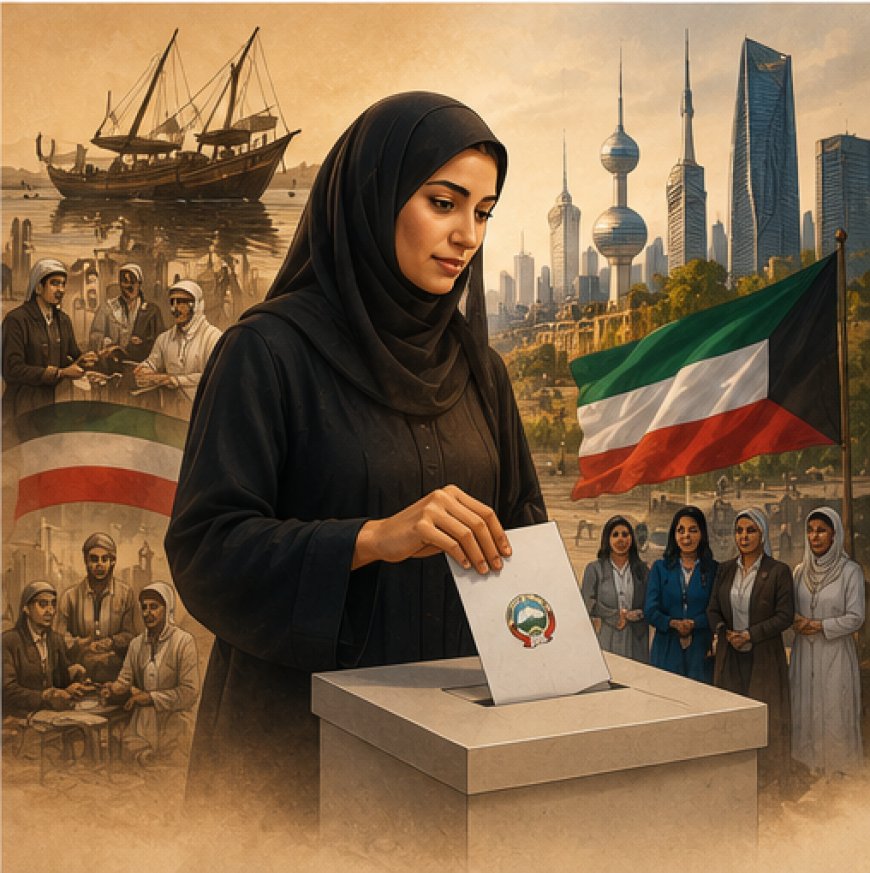
Kuwait was a small, coastal society, The merchant harbor society whose economy relied heavily on maritime activities such as fishing, pearl diving, and trade, was a melting pot of culture, and an assimilation hub for people from various cultures, customs and backgrounds. The community was organized around extended families and tribal affiliations, with social and economic life centered on the sea and local markets and trade. Women's roles were traditionally confined at times to domestic responsibilities, but they also contributed to family businesses and supported community life, especially during the long absences of men at sea. The pre-oil era was marked by a simpler lifestyle, strong social bonds, and a reliance on traditional customs and values.

Women role in the society was as important and on par with men’s role, they held the family responsibilities, financially and socially, while the men were on the long arduous journeys covering thousands of miles between the eastern African shores and the Indian ocean.

While women in pre-oil era Kuwait played crucial roles within families and communities, their participation in formal political life was notably absent. Political authority and decision-making were primarily reserved for men, centered around the ruling Al-Sabah family, influential merchant leaders, and tribal elders who convened in the Majlis (council). These councils served as spaces for governance, consultation, and conflict resolution, but women were excluded from direct involvement or representation. Despite their significant contributions to the stability and well-being of society—managing households, supporting family enterprises, and maintaining social ties—women’s voices and perspectives were not part of the formal political processes. This exclusion reflected broader traditional norms, where leadership and public decision-making were seen as male domains, and women's influence was largely restricted to the private and domestic spheres.

This could be explained as an indication to the greater responsibilities women had to uphold the family and thus the society.

.

.

The legislative vacuum that led to depriving women from political participation:

The first Shura council (April 1921), Municipal council (1934), Council of education (1936), Legislation council (1938), and the Constituent assembly (1961), all these councils operated without the presence and participation of women. This absence led to a legislative vacuum that the Islamic and conservative political members used to exclude women from participating politically in the elections and/or the parliament: The constitution didn’t explicitly mention the right of suffrage and political representation was exclusively for men, as stated in articles 29 and 82 of the Kuwaiti constitution:

Article 2G:

All people are equal in human dignity, and in public rights and duties before the law, without distinction as to race, origin, language or religion.

Article 82:

A member of the national assembly must:

a)      Be originally of Kuwaiti nationality in accordance with the law.

b)     Fulfill the voter’s qualifications in accordance with the electoral law.

c)      Have attained at least the age of thirty Gregorian calendar years (30 years) on election day.

d)     Have a sound reading and writing knowledge of Arabic.

The Election law 35/1G62 article 1 however excluded women by exclusively limiting the right to elect for males:

“Every Kuwaiti male who is 21 years old has the right to elect” Article 125 of the constitution:

Any person entrusted with a ministry shall fulfill the conditions in Article 82 of this constitution.

And this article states that the requirement of appointing a minister must fulfil the

requirement of article 1 of the election law, thus leading to denying and depriving women the right to even be appointed as a minister and the right of suffrage!

This constitutional conflict with the Electoral law started an ongoing struggle for women to regain their 3 rights, the right of suffrage, representation and appointment as ministers or parliament members (nomination, election and appointment as ministers or PMs).


The struggle

The Family Renaissance Association (an NGO led by Noriah Al-Saddani) held the first conference for Kuwaiti women in December of 1971, the conference concluded with submitting the first petition demanding women’s political and social rights to the speaker of the National Assembly (the parliament) Khalid Al-Ghunaim, the petition was denied later on after attacking the movement and declaring the petition is in contradiction with religion.

Draft amendments to the articles 1 and 19 of the election law 35/1962 presented by PM Ahmad Al-Tukhaim in August of 1981 were rejected by the parliament the next year, after harsh debates among the members, the draft suggested to transfer the exclusivity of political participation for males, from article 1 to article 19, thus continuing the denial of women suffrage. 

And in May 1999, Shaikh Jabir Al-Sabah emir of Kuwait issued a decree granting women the right to vote and run for office, during parliamentary recess, 2 weeks after the dissolution of the assembly, which led to the rejection of the decree twice by the tribal and Islamist PMs along with some liberal PMs who questioned the decree’s constitutionality and feared for their own prospects of winning seats once women were allowed to participate in politics. That led the liberal forces to revise their stance and their representatives quickly and joined with Shi’a leaders and several women’s organizations to initiate a wide scale campaign, and on May 16th 2004, 22 years ago, the cabinet passed a new suffrage bill that was referred to the assembly for approval, but it was not approved until a year later thanks to the prime minister’s efforts at the time (Shiekh Sabah Al-Ahmad Al-Sabah), it is worth mentioning that a similar bill granting women the right to participate in city council (municipality) elections was rejected by the members on May 4th 2006.

.

However, the amendment of article 1 of the electoral law no.35/1962 also included a vague clause introduced by Islamist MPs stipulated that:

“Women’s participation should abide by Islamic laws”.

Although women were granted the rights and being backed and supported by the government, no female candidate won a seat in the 2006 and 2008 elections of both the parliament and municipality elections. The appointment of Masouma Al-Mubarak as the first female cabinet member paved the way for women’s participation, and in 2009, 4 women were elected to the 13th National Assembly for the first time in Kuwait’s history (Masouma Al-Mubarak, Salwa Al-Jassar, Aseel Al-Awadhi, and Rola Dashti) despite having fewer female candidates than the previous elections!

No woman of the elected 4 PMs managed to retain their seats in the 2012 elections, and the short lived 2012 assembly had no women among them, but women managed to win 3 seats in the December 2012 elections (Masouma Al-Mubarak, Safa Al-Hashem and Thikra Al-Rashidi) Thikra was appointed as the minister of social affairs and labor.

Only Safa Al-Hashem managed to secure her seat after the cancelation of the December 2012 elections, but she resigned along with 4 other MPs following the rejections of their request to question the prime minister Shiekh Jaber Al-Mubarak Al-Sabah over corruption allegations.

The 2022 elections saw Jenan Bushehri win her first seat, and she later on became the first woman to win a seat in 3 consecutive elections. Jenan returned to the parliament after the 2023 elections with Alia Al-Khalid but was the sole female representative after the 2024 elections.

.

The anatomy of the problem

The 2022 elections saw Jenan Bushehri win her first seat, and she later on became the first woman to win a seat in 3 consecutive elections. Jenan returned to the parliament after the 2023 elections with Alia Al-Khalid but was the sole female representative after the 2024 elections.

Women’s marginal presence in the Kuwaiti electoral arena is commonly attributed to cultural, institutional, and structural factors. A conflict between a modernizing and development-oriented perspective and a religious-tribal perspective.

(Rola Dashti).

The low level of confidence in women’s abilities as political leaders, and women’s lack of confidence in their own abilities combined with the prevailing attitudes concerning the role of women in the public sphere and patriarchy-enforcing norms have immensely contributed to women’s political underrepresentation.

Dr. Masouma Al-Mubarak, the first female minister in Kuwait’s history said that Kuwaiti women have their rights and duties, and they have played their role to constitute a significant percentage in the state sectors especially in education and health. Dr. Al-Mubarak added that Kuwaiti women have been empowered to hold positions in all sectors and have proven their impressive excellence and that they are scientifically and professionally qualified in various fields. She pointed out that the first part of empowering women is related to the woman herself, as she must strive and struggle, and the second falls on the responsibility of institutions, decisionmakers, and laws to develop women’s capabilities.

It is noted that the patriarchal system has permeated into the Kuwaiti civil society, becoming an obstacle to its transformation and success into a fundamental force for social change. Women's movement in Kuwait have not been consistently instrumental in advancing the status of women, unlike in other regions of the world. Instead, women's organizations have been criticized for adopting a patronage-based leadership style, thus mimicking the patriarchal system generally present in their social circles. With the exception of a few isolated cases where women assumed leadership roles in advocacy and reform (the first Kuwaiti Women conference in Dec. 1971, Abolish 153, the simultaneous campaigns against censorships between 2018-2020).

The lack of confidence is a primary reason for the underrepresentation of women in formal political institutions, whether parliaments, ministries, or political parties. Armed with confidence and determination, women can reach the highest levels of the political process. Therefore, they must believe in their abilities and completely abandon the widespread notion that men are the leaders. Women will not become equal to men, possessing the same capabilities, unless they can fight for their rights. The continuous struggle for power and political polarization over the past century further weakened and fragmented marginalized groups including women (e.g. the liberals, the social and progressive movements, the secularists). The lack of organized political party systems with clear agendas, coupled with the dominant tribal structure of the Kuwaiti electoral landscape, has complicated women’s ascendency to leadership positions. And for the exception of Thikra Al-Rashidi, no woman managed to win a seat in the 4th and 5th electoral districts (who are predominantly tribal). Female politician’s lack of political expertise and sustainable financial resources, along with little coordination among women’s organizations and other female politicians, have negatively impacted their ability to play a more substantive role in the legislative arena, and the prevailing levels of corruption in the Kuwaiti electoral arena are crippling women’s ability to compete effectively and fairly in elections.

.

Conclusion

To summarize what is needed to ensure the effective empowerment of women in Kuwait:

  • Establish political, institutional, and financial guarantees that encourage women's candidacy, ensuring equal participation of female candidates in election campaigns.
  • Design legislative regulations that guarantee the effective implementation of the quota system.
  • Create educational programs and centers designed to prepare women for political work.
  • Establish schools (or centers) to train women to participate in election campaigns and provide them with support.
  • Improve leadership skills of female candidates:
    • Using social platforms such as cultural gatherings and Diwanias to practice addressing public and political debates.
    • Using social media outlets such as X, Instagram, Tic toc, and others to reach the target audience and voters.
    • Capacity building programs aimed for women.
  • Improve political and social participation:
    • Establish communications between civic political parties and female candidates by creating a communication platform and assigning liaison officers for every candidate.

    • Gaining media attention, by studying social interests and conducting social studies to identify the priorities of the society.
    • Documentation to ensure continuity, consistency, accountability, transparency, and historical accuracy.
    • Sustainable funding and campaign finances to enable the female candidate’s independence and avoidance of illicit practices.
    • Support of the government.